CityLife residences in Milan. Triple skin facades by Zaha Hadid: aluminium, wood and glass.

28 February 2019

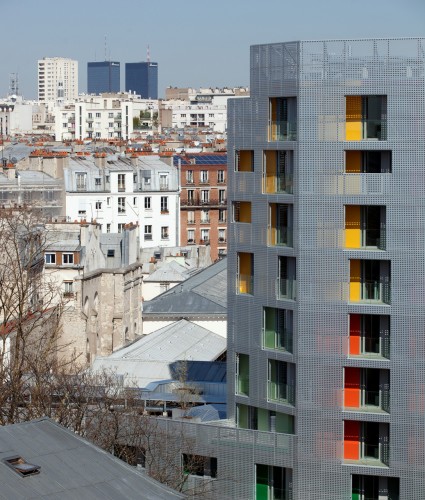
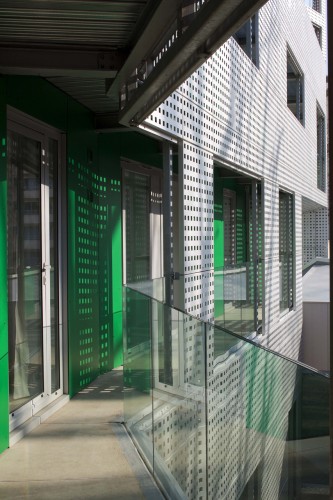
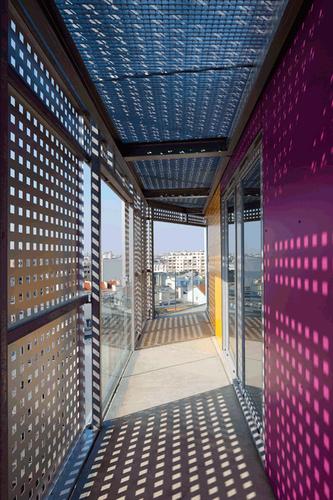
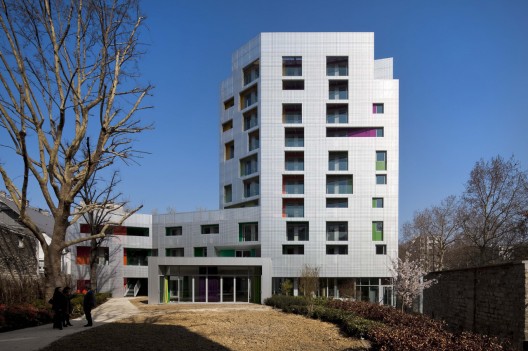
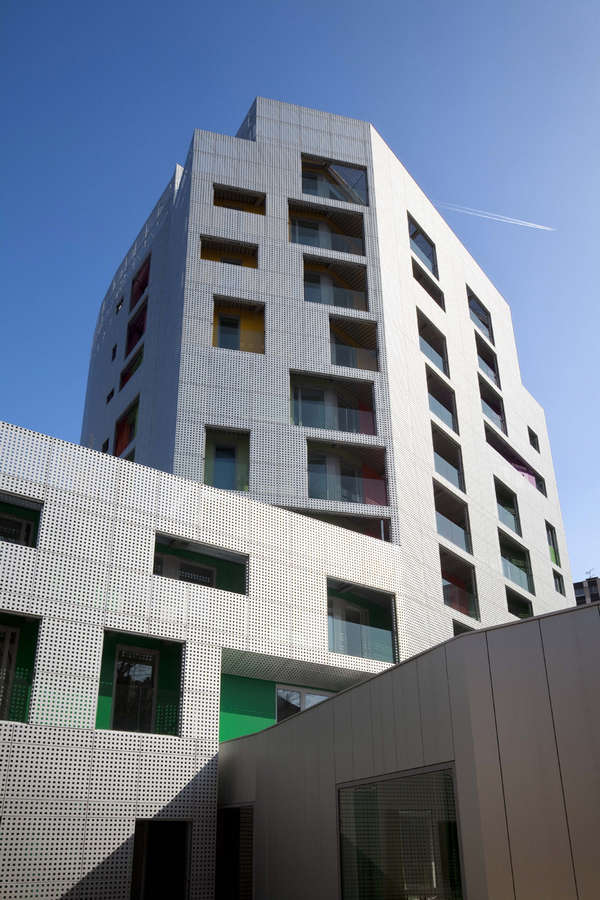
The citylife project located in the heart of Milan -- in the centre of the historic fiera area immersed in a park of 160,000 square metres (one of europe’s largest pedestrianized zones) -- involves a group of architects rather than a single designer: Zaha Hadid, Arata Isozaki and Daniel Libeskind. CityLife, Zaha HadidCitylife brings to the urban context a new model for work and leisure, an area to be enjoyed on foot or by bicycle, with traffic circulating only underground. At the centre of the project is the business district -- three office towers in the 'piazza delle tre torri': torre Isozaki (il dritto, the straight one), torre Hadid (lo storto, the twisted one) and torre Libeskind (il curvo, the curved one) -- torre isozaki will be 202 meters high (663ft) with 50 floors, making it amongst the tallest in Italy by roof height. Torre Hadid will be 170 meters (558 ft) high with 44 floors, and torre libeskind will reach a height of 150 meters (492 ft) with about 30 floors. The three towers are able to accommodate ca. 10,000 people, over a total of approximately 130,000 m2. CityLife, Zaha Hadid A Contemporary Art Museum, a shopping area with bars and restaurants, and a pavilion for exhibitions, sports, entertainment and fashion shows are also part of the project. CityLife, Zaha HadidThe skyline of Zaha Hadid's CityLife Milanohousing complex is defined and characterized by a sinuous fluid line. The residences are comprised of seven curved buildings of varying heights, from 5 to 13 floors. The distinctive architectural elements include a serpentine movement of the curved balconies and the profile of the roofs, which provide a soft and elegant shape for all of the top-floor penthouses, complete with extensive covered terraces. Construction of the residential complex began in august 2009, with delivery of the first apartments scheduled for 2013. CityLife, Zaha HadidGreat care has been given to the site and building orientation, taking into account environmental and comfort requirements so that most apartments face south-east and at the same time allocate the best views from the terraces, towards the city or the public park. The façade materials - fiber concrete panels and natural wood panels - emphasize the complex's volumetric movement and at the same time give a private and domestic quality to the interior of the residential courtyard. CityLife, Zaha HadidThe interiors open onto extensive terraces. All of the apartments feature structural and plant solutions that can be easily adapted to individual needs. Each of the homes is different from the others in terms of size, exposure and layout: from two-rooms to large family apartments and twin-level penthouses. At ground level, the double-height lobbies are flooded with light by large openings stretching from floor to ceiling, designed to confer strong visual continuity with the park. access to all stairwells is provided by main and service lifts. The underground parking areas lead directly to the individual buildings with easy, convenient and secure access. (Fabiana Cambiaso) www.zaha-hadid.com www.city-life.it/it/ © zaha hadid architects; © CityLife   Residences Hadid, Milan, Italy Zaha Hadid Architects, Permasteelisa Spa Area: 45.000 sqm (300 units) Completion: 2015 Materials: Aluminum, Galvanized Steel, Glass, Wooden Slat Panels Applications: Envelope.

Marco Mignatti    

Architecture

Ice facades. Glass panels and transparency to reduce the demand for energy

01 October 2018

A new architecture in Imola’s skyline. A cube designed with targeted policies to reduce the energy demand to improve comfort. This is an idea signed by A2 Studio Gasparri and Ricci Bitti Architetti Associati, which translates into a careful design of the exterior and an accurate choice of materials.

Cubo di Luce

The facades to the East and North were entirely made out of glass on a steel frame. They allow maximum exploitation of solar radiation in the early hours of the morning without bothering with a bright light indoors. The two most elaborate facades are South and Southwest: they have not only an aesthetic function. It's a wrap created from a masonry almost devoid of views and a second skin in extra clear screenprinted glass panels that protect the most sun and wind exposed sides. Between the two layers, there is a cavity of about 80 cm, where the air circulates in a natural way, and it helps cool the surface in summer and retain warmth in winter.

Cubo di Luce

The project focuses on transparency, opting for full-height windows and creating inside rooms separated by glass, so as to generate a visual continuum between the halls. An architecture that from afar evokes an ice cube from the many reflections of light, as you approach the eye is drawn to the complexity of the details, such as the relief surface, geometric motifs that recur in seemingly random fashion. At night the transparency is accentuated by the lighting design which makes the cube even more.

Cubo di Luce

Cold items such as glass, white, soft light contrast with hot elements and materials: the red door, the use of stone, greenwood, external, internal dark wood. A game of elements that gives character and dynamism to building. Cubo di Luce

Marco Mignatti

Facades

Zintek®: zinc-titanium's steel mesh

19 October 2018

The Psenner distillery is a space that combines innovative design and tasting, and the first European project made with zinc-steel mesh titanium by Zintek®. One of the most famous distillery in South Tyrol, and established itself at the international level, Psenner is over 60 years grappa and distillates' synonymous. The company want to communicate its own identity based on transparency and visibility, this inspired the architects Freissinger and Elzmbaumer, who have built the project: the image of manufacturing processes move from inside to outside. The skin envelope comes from the three basic stages of Psenner production - distillation, evaporation and condensation - occurring in copper stills and tubes. These produce tube shapes that characterizes the showroom, and Onyx backlit display changes color creating a different atmospheres. And here the "bubbles" of steam come, as round shapes in the steel's zintek® mesh which is the production's shed covering. The sheet metal, chosen for its texture, was deliberately mounted to reverse, with openings upward to maximise the nighttime lighting, through white light filtered by satin glass, which lit up from within the walls of the building. An effect of great suggestion possible by the workmanship of the slabs and the quality of the workers who have made the work, the Schmidt AS Bolzano. Zintek ®, is therefore ideal for innovative project due to its excellent processability and able to blend perfectly with other materials used, first of all, the total white glass that reduces the difference between internal and external. The Psenner's new headquarters is today a point of reference for the world of wine (it will be promotion site for events and educational and informative activities) as well as industrial design. (Fabiana Cambiaso Università La Sapienza Roma).

Carlo Bardelli

Materials

Land Art in Paris. The glass behind a wooden enclosure

30 November 2018

The nature converses with the city. The French architect Stephane Malka, a former graffiti artist and author, presented the project of a restaurant with an interesting exterior in Paris. A wooden casing protects glass structure: a meeting of different materials to represent the relationship with nature. EP7 restaurant stephane malka"The restaurant EP7 evokes the myth, represents the return to an original architecture, reminiscent of a mountain, a forest, a summons. It represents the desire to reconnect with our roots, creating a more harmonious relationship with nature" the artist explains. An urban art, or Land Art, project, Stephane Malka summarizes. EP7 restaurant stephane malkaThe raw wood becomes the bark that, with irregular profiles, covers, almost to dominate, the building. The latter was achieved with large transparent glass that are seen in a trunk and the other up to dominate on the main façade. The vegetation also characterizes the exterior of the building: flowers, trees and plants grow on vertical walls. EP7 restaurant stephane malkaThe restaurant is on three levels, the interior is free of invasive architectural elements; the setting is white, the transparency and natural light dominate. These are choices that enhance the wood bark dominating up penetrate the perimeter of the building. EP7 restaurant stephane malkaAn architecture that wants to be a provocation, both hybrid construction and artwork. www.stephanemalka.com

Carlo Bardelli

Materials

The Metaphone®, concert hall and urban music instrument

The Metaphone® is the contemporary keystone of the whole project, embodying the site’s new musical and acoustic role. An architecture of materials, sound and light, it is the emblematic space of 9 – 9bis: a building to be looked at and listened to, an immense instrument played by musicians who are alternately invisible or in the limelight. The musical flow of the site strikes its walls and makes them sing. And like music, it evolves in time, in the passing of time: it is transformed into harmonies of sound and colour, fluid, fleeting, but constantly renewed, which will become the spirit of the place. META-AMORIN

The Metaphone® is both concert hall and “urban musical instrument”, whose walls produce and diffuse sounds, in harmony with the play of light. The concert hall and its annexes (technical rooms and audience boxes) are contained within a volume of black concrete, itself wrapped in a light skin made of scales of different materials: ground glass, steel, wood... This scaly skin extends outwards and opens above the concourse, forming a great porch protecting the entrance and terrace. Between the concrete mass and the scaly skin, attached to a metallic structure, technical walkways are provided for installing and maintaining the sound and lighting equipment. On the roof, the lattice of scales extends into a sheet of integrated photovoltaic cells. The instrumental elements are made up of plates of different materials, whose acoustic properties have been calculated to produce musical sound. There are two principles of sound production: mechanical or electroacoustic, with vibrating bowls mounted on the plates to form loudspeaker membranes (this technique is commonly used in the car industry). These systems have been developed and tested by making a prototype of the musical facade, composed of 8 modules measuring 1.2 m, half fitted with an acoustic instrument, the other half with vibrating plates.

META-AMORIN

What can be composed with such an instrument? Obviously, it is not a tool for producing special effects. On the contrary, the aim is to give a totally and resolutely musical shape to a concert hall built on a site dedicated to music. Undoubtably unique. The principles of composition include factors relating to architectural space, materials and light. Factors relating to environment and use, to maintenance and cost... One can only imagine the variety of timbres that can be produced. In addition, the dimensions of the hall offer a playing area great enough for an orchestra bigger than Berlioz himself could ever have dreamed of. It is an exceptional space which will make it possible to invent musical forms commensurate with the architecture. Composers from all over the world will be invited to create works for this auditorium. This is how the originality and power of the project will be maintained. META-AMORIN

For the public, the Metaphone® is likely to be a “curiosity”. People will come to Oignies to see and hear it. It will serve as a secular bell, marking the hours, midday or sunset. It will signal the beginning of a concert or the interval, produce a peripheral sound space, discreet so as not to inconvenience the neighbours … It could also be used as an instrument in an orchestral composition, with the musicians playing beneath the porch. META-AMORIN

(Fabiana Cambiaso, Università La Sapienza) Credits: www.herault-arnod.fr Figures: © André Morin; © Marie Clérin   Concert Hall, Oignies (Pas-de-Calais), France Hérault Arnod Architectes Site: 1 980 m² Completed: 2013 Materials: Frosted Glass, Wood, Corten Steel Applications: Envelope  

Materials

Nasce la partnership tra Syncronia e Jannelli&Volpi

Nel contesto del fuorisalone (17/22 aprile 2018), Jannelli&Volpi presenta l'evento 'Wallpaper Land', a cura di Matteo Ragni Studio. 
‘Wallpaper Land’ nasce dal voler raccontare il dietro le quinte di un’azienda - Jannelli&Volpi - che ha fatto della sua italianità e capacità produttiva altamente tecnologica, il successo nel settore della carta da parati. Che esporta da quasi sessant’anni, in tutto il mondo.Una storia che parla del prodotto. In fabbrica. Il luogo da cui partono le storie che scorrono e sono narrate sui rolli, che diventano carte da parati e viaggiano per arrivare a destinazione. Negli ambienti di chi ha scelto di raccontarle, sui muri delle singole architetture.
Nel contesto di questo evento, presenta il nuovo format PROJECT LOUNGE, che l’azienda italiana - leader nel settore dei rivestimenti murali e tessuti d'arredo - ha deciso di dedicare al contract - che occuperà in modo permanente un’intera sala al primo piano della sua storica sede di Milano (Via Melzo 7) - ideata per essere punto di incontro tra la fase produttiva e il prodotto, per professionisti e ambienti contract. Con la progettazione ideata insieme a Matteo Ragni Studio, la Project Lounge di Jannelli&Volpi vede protagonisti Syncronia - grazie alla partnership appena avviata - isieme a Hay, VeryWood e Waldmann.


Architecture

Cement and steel. Bio Museum signed by Frank O. Gehry

30 November 2018

Concrete and steel are the protagonists of the skeleton of new Biomuseum of Panama designed by Frank O. Gehry. It is an eclectic, asymmetrical, projecting and convoluted structure with canopies that overlap to form a collage of shapes and colors that catch the eye.

Biomuseum Frank Gehry

The building consists of three main elements: Museum, Design Gallery and Park. The structure is based on thick concrete “trees” that hold various metal clad similar to canopies in a series of curved and bent geometries. Biomuseum Frank Gehry

"The bridge of life" is the Museum’s name, conceived in order to teach and disseminate the importance of biodiversity. An irregular shape that looks like a representation of the natural forces that shape our world. Biomuseum Frank Gehry

Structural elements also become education points that describe the impact of mankind on the Panamanian ecosystem. Panama is not only one of the places with more biological diversity in the world, but it is also home of some of the most studied ecosystems. Biomuseum Frank Gehry

www.biomuseopanama.org   www.foga.com

Marco Mignatti

Architecture

Fibra di carbonio e robot. Il padiglione "coleottero"

02 October 2018

L'Istituto per Design Informatico (ICD) e l'Istituto di Strutture edilizie e Progettazione Strutturale (ITKE) dell’Università di Stoccarda hanno realizzato un padiglione che ricorda visivamente e materialmente un insetto, o meglio un coleottero. Il gruppo di lavoro non è certo nuovo a questi progetti: recente è infatti un altro padiglione basato sull'esoscheletro di un'aragosta e una struttura progettata e costruita invece sul modello dello scheletro di un riccio di mare. Il progetto è basato sullo sviluppo robotizzato per moduli delle doppie strutture composte da strati di fibra di carbonio: in questo modo l’intera architettura rimane minima e leggera, permettendo un elevato grado di libertà geometrica. Si estende su una superficie di 50 metri quadrati, ma pesa solo 593 chilogrammi.

Beetle-Shells-Structure-7-495x350

Il team di ricercatori e studenti ha utilizzato modelli 3D ad alta risoluzione di vari gusci di scarabeo - noti come elitre – per condurre un'analisi delle strutture interne complesse, lavorando a stretto contatto con biologi e paleontologi dell'Università di Tuebingen.

Beetle-Shells-Structure-6-495x350

Queste strutture sono state poi convertite in una serie di principi di progettazione, realizzati con vetro e fibra di carbonio polimeri rinforzati per dare il padiglione un rapporto resistenza-peso ottimale. "Il progetto presenta un nuovo approccio alle strutture in fibra composita in architettura", ha spiegato ICD ricercatore e membro del team Marshall Prado.  

Edoardo Croci

Materials

Glass or marble?

08 January 2019

An outer shell to protect the precious contents within: that's the goal of the façade of the Library at the Folkwang University in Essen, Academy of music and art in the region of Rhine North-Westphalia. A particular crystal structure features one side of the building. The exterior consists of glass panels with an impressive optical effect: thanks to the use of a special photographic technique applied to glass, viewers live in the illusion of being in front of a stone material. Folkwang University2These images depict the rough stone in its original size. In this way you can see the shadows of those beyond the façade and natural light is filtered inside the library. At night, the building also illuminates the outer space. The façade is attached to the bearing structure of reinforced concrete building with a vertical system. The concrete pillars were sized and positioned according to the proportions of internal racks, where library’s volumes are housed. The cherry wood used for shelves and furniture was used for the coating of the pillars also, but not everyone is designed as carriers: inside the cavity of some, there are the piping of air-conditioning systems. The building was designed by architect Max Dudler, in collaboration with photographer Stefan Müller. The Folkwang University is a charming building, housed inside the old Benedictine monastery of St. Ludgerus.   www.maxdudler.com

Edoardo Croci

Facades

ArboSkin: bioplastica riciclabile per facciate innovative

15 Ottobre 2018

L'università di Stoccarda ITKE Institute, Dipartimento di Strutture e Costruzioni della Facoltà di Architettura, nell'ambito del Research Proiect Bioplastic Facade, ha progettato e costruito il nuovo padiglione ArboSkin: è composto di 388 piramidi di bioplastica, materiale totalmente biodegradabile o riciclabile derivante da materie prime vegetali rinnovabili annualmente, come l'amido di mais o la farina.

ArboSkin  

L'intero padiglione è realizzato con elementi di facciata in 3D e dimostra le potenzialità estetiche e strutturali delle bioplastiche. Ha vinto recentemente un premio in uno dei più importanti concorsi tedeschi sulle idee innovative.ArboSkin  

La bioplastica è un materiale estremamente malleabile, ma con buone prestazioni strutturali, particolarmente adatto nello sviluppo di facciate complesse e con motivi in rilievo. Allo stesso tempo consente di rispondere alla crescente domanda di materiali da costruzione provenienti da risorse efficienti e sostenibili, limitando l'utilizzo di derivati da combustibili fossili. ArboSkin

Il progetto della struttura a guscio è basato su una rete di forme triangolati in pezzi tetraedrici di dimensioni diverse. La doppia pelle curva è fatta con piramidi di bioplastica di 3.5 mm di spessore che vengono assemblate meccanicamente per creare la superficie di forma libera. La forma complessa a doppia curvatura portante è realizzata collegando tra loro i tetraedri con anelli di rinforzo e travicelliI fogli di bioplastica possono essere modellati e adattati liberamente per soddisfare qualsiasi esigenza estetica dell'edificio.

ArboSkin

I fogli di bioplastica sono stati plasmati e termoformati ad alta temperatura consentendo di coniugare una elevata adattabilità ai disegni più complessi e i rifiuti prodotti durante la fresatura sono stati recuperati, ricostituiti e riutilizzati per creare altri elementi di facciata tridimensionali. I granuli di bioplastica sono estrusi in lastre, che a loro volta sono ulteriormente elaborate in base alle singole esigenze per ottenere superfici e strutture anche di notevole complessità. I prodotti semilavorati sono utilizzabili sia per rivestimenti esterni sia per rivestimenti interni. A fine vita il materiale può essere riutilizzato o smaltito tramite compostaggio. ArboSkin

Finora le bioplastiche erano state utilizzate solo per il confezionamento ma questo padiglione dimostra che il materiale può essere promosso ad alternativa verde al cemento, la cui produzione rappresenta l'otto per cento delle emissioni globali di anidride carbonica. (Fabiana Cambiaso Università La Sapienza) www.itke.uni-stuttgart.de ©ITKE; ©Roland Halbe.

Carlo Bardelli        

Facades