The "Contrasts" of Color between Planium Metals for Classic and Innovative Scenarios

In our language the word "contrast" often takes on a negative connotation, but in the history of color and therefore of aesthetics this is not always the case, on the contrary: it is precisely the coupling of what is dissimilar, sometimes completely antithetical, to generate a fruitful harmony. Think of Pantone's choice of 2021 to put together two meanings and two colors so distant from each other, Yellow and Gray.
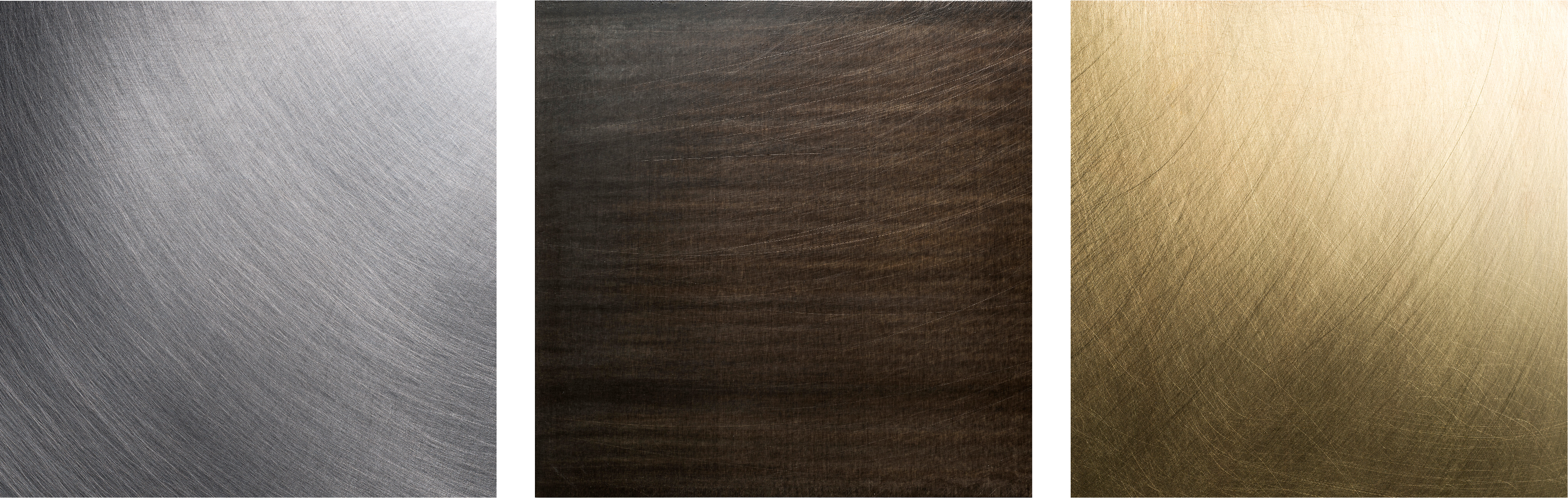
This is one of the cases to consider for Planium metals, since with their chromatic diversity these light up each other in an Interior Design project. The Tiziano red of the Copper, for example, can make a pleasant “contrast” if placed next to the Air Force Blue of the Calamine, or a cold brushed stainless steel. All types of steels work well with dark Calamine, but above all warm tones: a metal, for example, with golden shades such as Brass. Then there is the possibility of daring and playing with more unexpected and unusual, less classic, almost completely new combinations: bringing the brown Oxidized Steel closer to the Stainless Concrete - which is light gray; or finalize a composition with multiple metals using Calamine as a watershed to generate different series.
 

Planium metals


Zintek®: zinc-titanium's steel mesh

19 October 2018

The Psenner distillery is a space that combines innovative design and tasting, and the first European project made with zinc-steel mesh titanium by Zintek®. One of the most famous distillery in South Tyrol, and established itself at the international level, Psenner is over 60 years grappa and distillates' synonymous. The company want to communicate its own identity based on transparency and visibility, this inspired the architects Freissinger and Elzmbaumer, who have built the project: the image of manufacturing processes move from inside to outside. The skin envelope comes from the three basic stages of Psenner production - distillation, evaporation and condensation - occurring in copper stills and tubes. These produce tube shapes that characterizes the showroom, and Onyx backlit display changes color creating a different atmospheres. And here the "bubbles" of steam come, as round shapes in the steel's zintek® mesh which is the production's shed covering. The sheet metal, chosen for its texture, was deliberately mounted to reverse, with openings upward to maximise the nighttime lighting, through white light filtered by satin glass, which lit up from within the walls of the building. An effect of great suggestion possible by the workmanship of the slabs and the quality of the workers who have made the work, the Schmidt AS Bolzano. Zintek ®, is therefore ideal for innovative project due to its excellent processability and able to blend perfectly with other materials used, first of all, the total white glass that reduces the difference between internal and external. The Psenner's new headquarters is today a point of reference for the world of wine (it will be promotion site for events and educational and informative activities) as well as industrial design. (Fabiana Cambiaso Università La Sapienza Roma).

Carlo Bardelli

Materials

TUTORIAL 3: Revit family – the abacus of furniture in the project

Guide for the creation of a "furniture abacus" view to be included within an architectural project 


Revit family

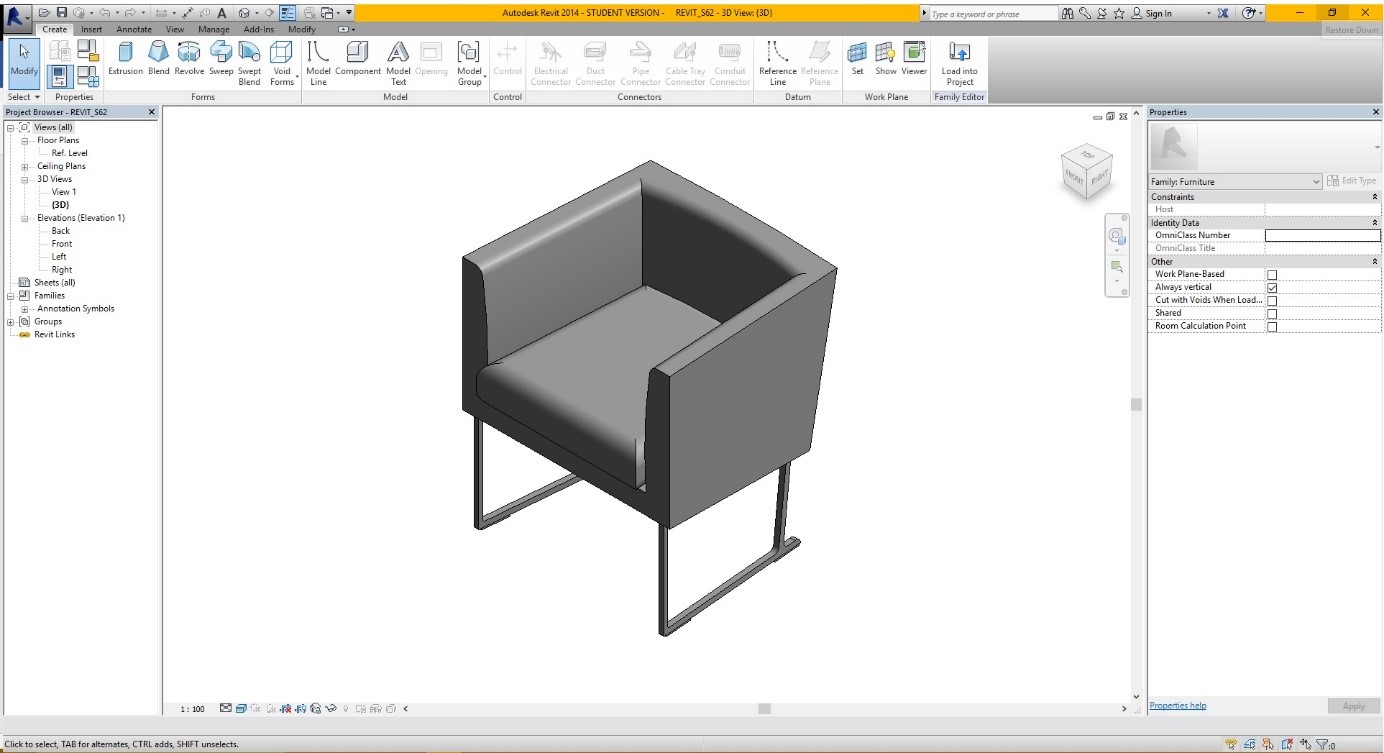
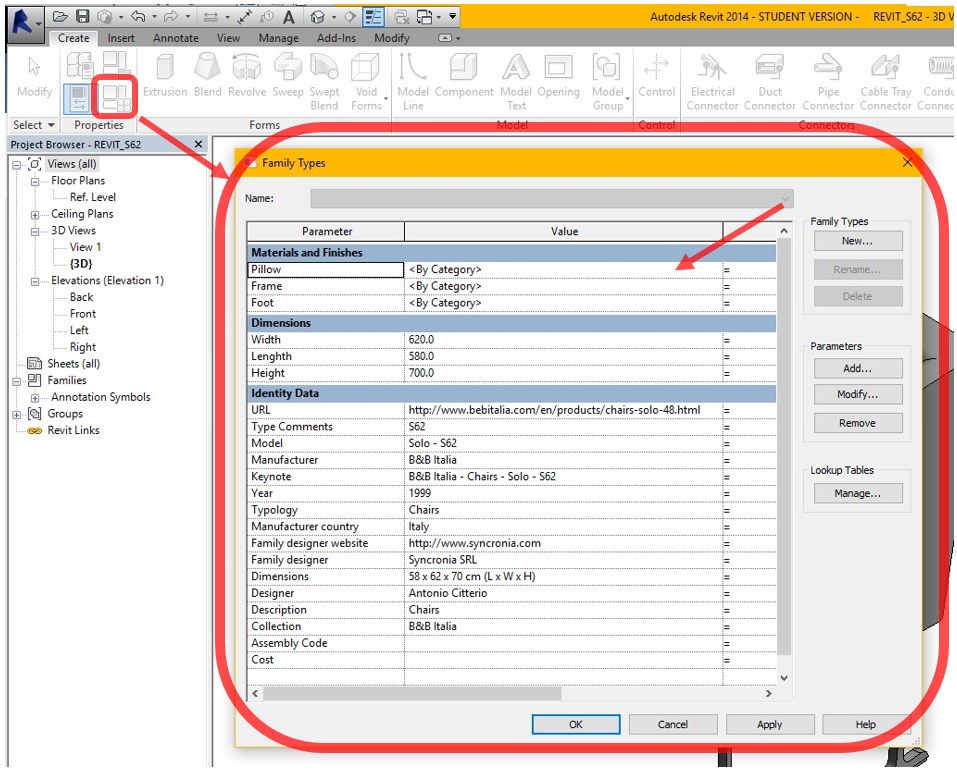
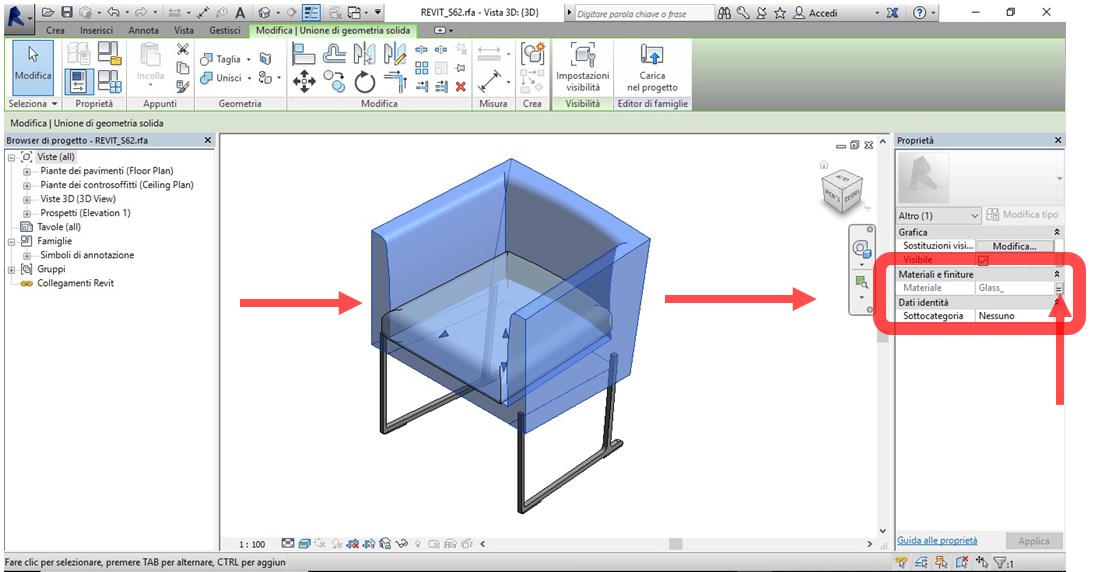
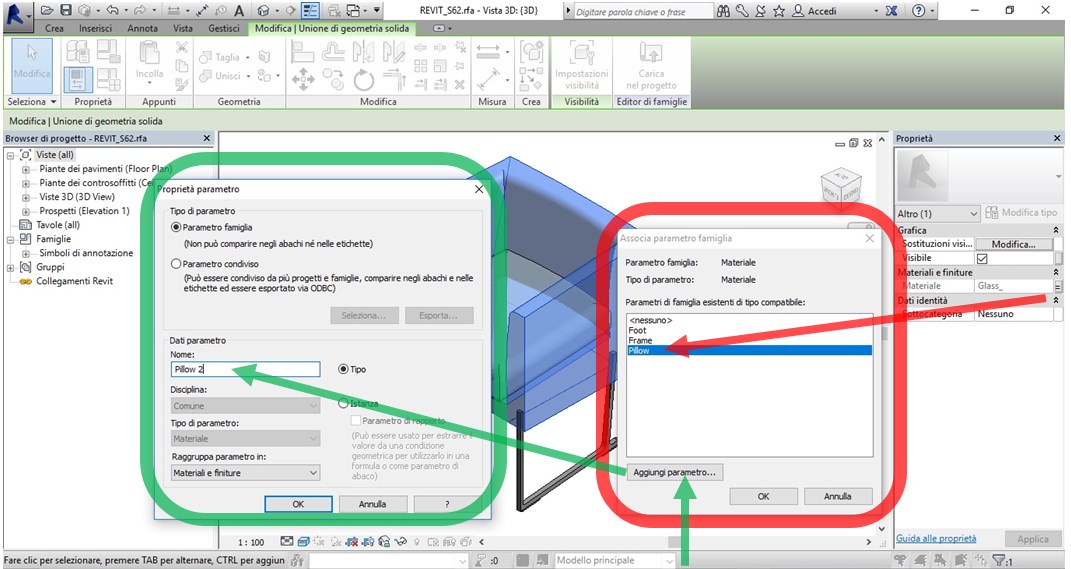
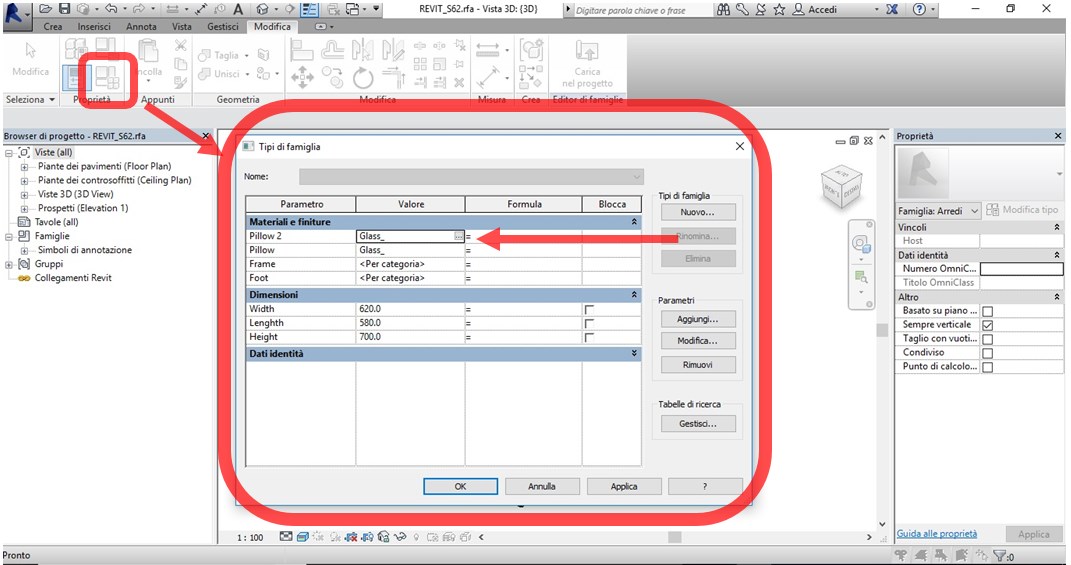
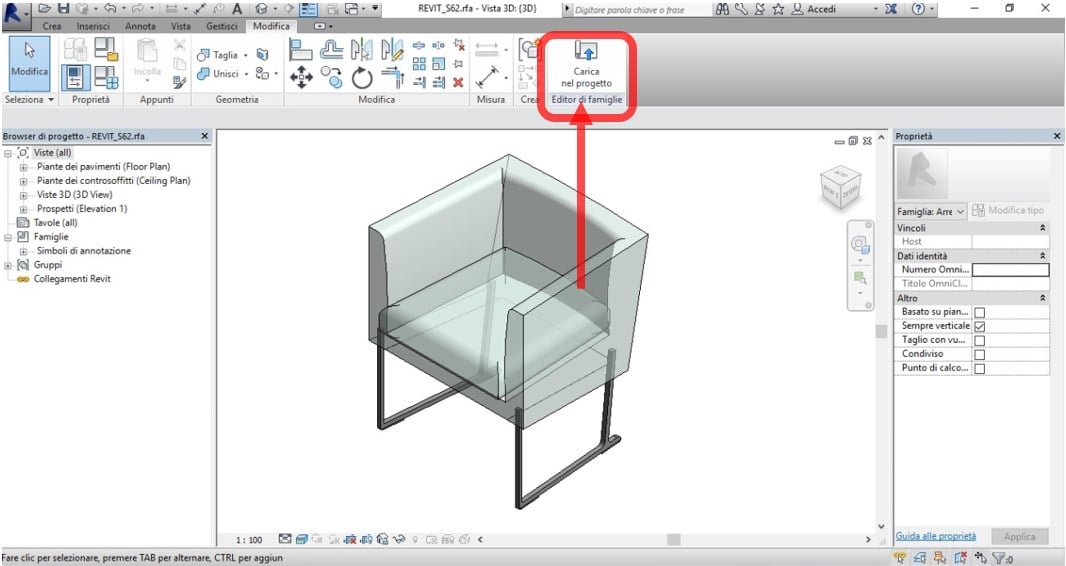
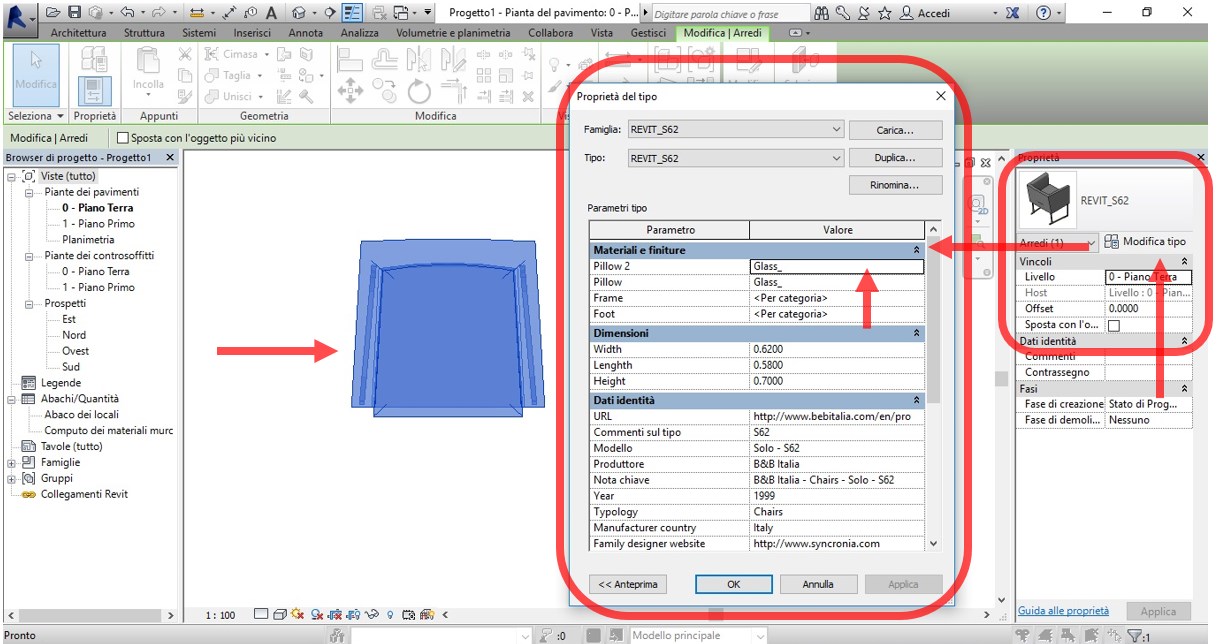
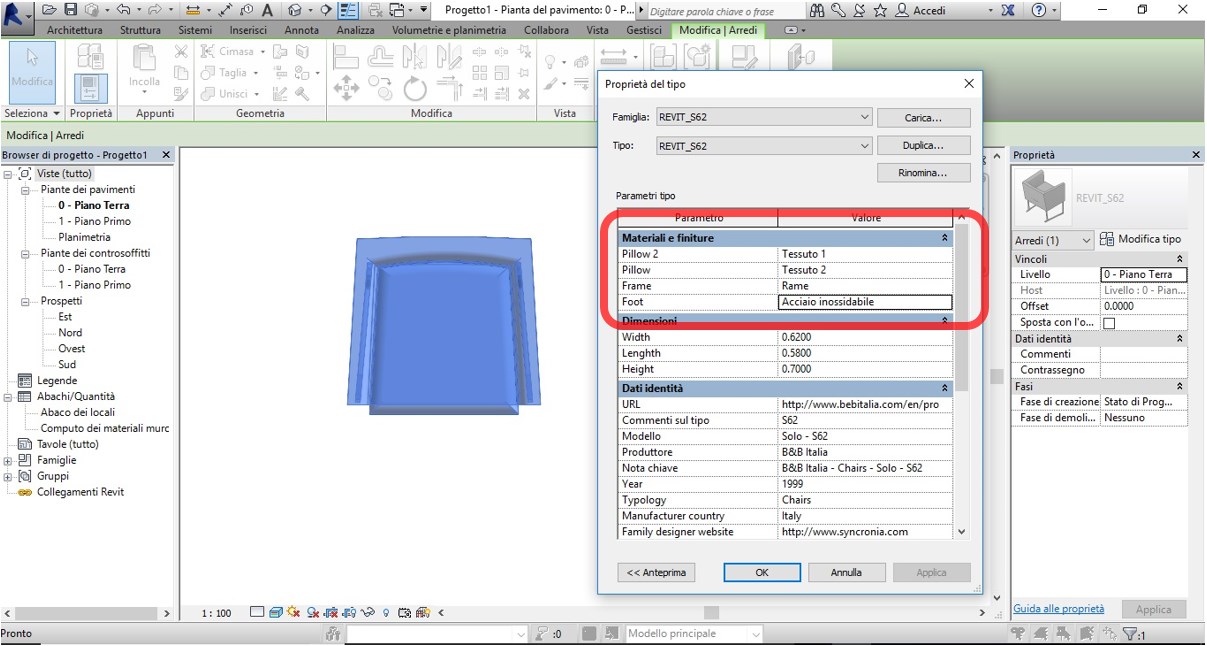
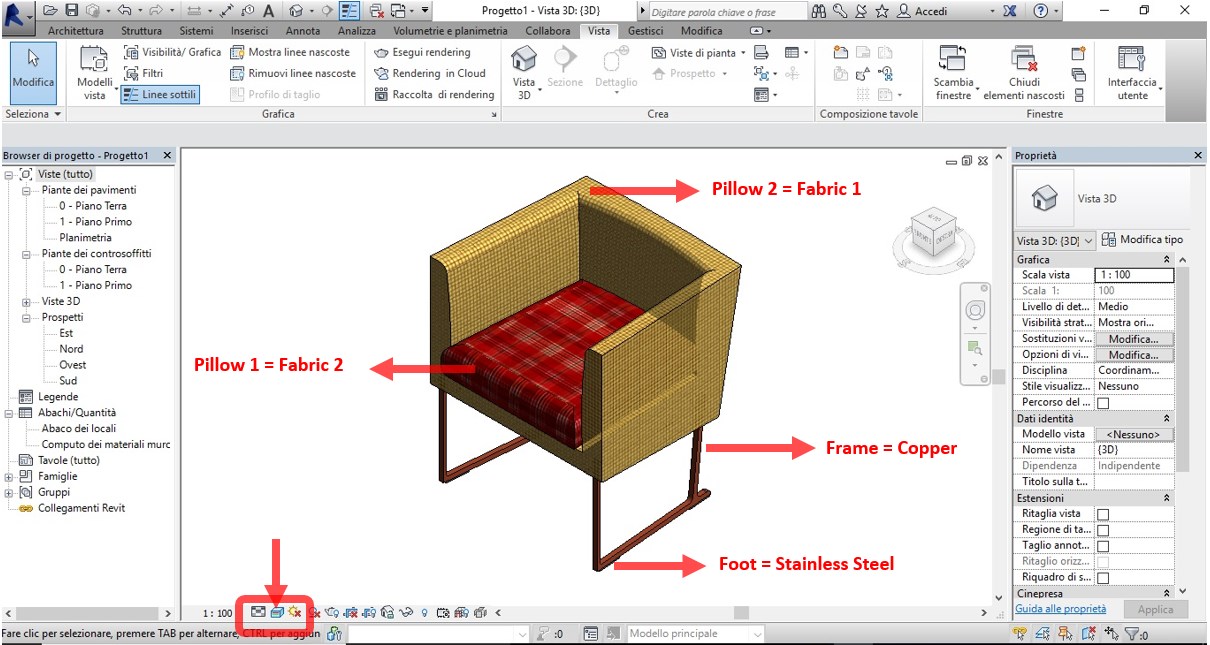
In this tutorial, we will continue to study the relationship between the parameters of the Revit family used as an example, the "Solo S62" chair and how they work within an architectural project.


Remember that the creation of BIM objects commonly called families in Revit is essential for the completion of 3D BIM models and their proper functioning.


The BIM Objects are commonly searched for on the Internet so that they can be included in a Revit design environment as Families without being modified in any way and will often ignore the fundamental characteristics, how they were made, with what parameters, what purposes they must fulfil, and what is the potential interaction with the 3D Model in construction.


Differently from what happens with a “.dwg” file in Autocad, or a “.ifc” file, a “.rfa” file (the Revit BIM Families are ".rfa" files, Revit BIM Projects  are ".rvt" files), when a "BIM Family" object is inserted in a Design Parametric 3D Model, the latter is enriched with all the information contained in the inserted object that can, therefore, be interrogated, edited, accounted for, etc.


They are interior design objects such as Chairs, tables, armchairs, and sofas, or real architectural models like doors, windows, textures, and coatings, etc. and, therefore, we need to know their characteristics to exploit better the potential and integration with the main BIM model that hosts them.


In the previous tutorial we saw how, in addition to performing a graphic completion function, a Revit family contains a series of information and functions that allow it to interact with the 3D model of the project that is intended to host it, these parameters, which we have previously defined as the output performance of the Revit family, may be retrieved at any time and in a different manner depending on the design requirements and within a BIM 3D project.


In particular, we have obtained a “Furniture abacus" that can be inserted into a project table containing a lot of information on the furniture items included in the BIM model.

tutorial 3 pic 1

                                                                                    Revit - furniture abacus – adding it to the project table

Furniture abacus

Now we will discuss the relationship between the parameters that exist within Revit families, and their retrieval (field) inside the architectural project graphically represented by the abacus.


We need to remember that Revit abacuses work like masks that contain and retrieve within them the parameters not only of some parametric families imported into the project but of the entire BIM 3D model, and therefore it is possible to combine and graphically retrieve fields that put into related parameters belonging to different objects.


The most immediate example that can be made in this regard is the compilation of an abacus, which in addition to providing a list of furnishings found throughout the model, provides more accurate and up-to-date information of the architectural design environment in which each specific furniture element is inserted.


A classical breakdown of furniture per room.
To do this, we need to complete the furniture by downloading and putting into distinct rooms further Design objects such as:
-    a bed; an armchair
-    a table
-    a chair; etc.


We place families, interior design elements, in the furniture project into distinct rooms such as the Living Room, Kitchen, and Bedroom, and give the BIM object a label by using the key note.

tutorial 3 pic 2

                                                                                                                         Furniture project – breakdown of rooms

As done previously, our furniture abacus is updated automatically.


We connect the new Interior Design Elements to their preview image by selecting the corresponding cell. The "Manage images" selector is displayed, select the image of the corresponding furniture and repeat the operation for any other new furnishing object present in the Architectural project.

tutorial 3 pic 3

                                                                                                       Furniture abacus - managing the preview image

Returning to our project table, we will have a view of the updated abacus.

tutorial 3 pic 4

                                                                                                     Furniture abacus - adding to project 1 table

Now, to group the furniture into rooms, different categories compared to those so far displayed need to be entered into the abacus using the same procedure.


Returning to the Abacus view of the furniture that can be selected in the project browsers, select "Fields" from the property bar of the screen and then select Room in the available fields of the property mask

tutorial 3 pic 5

                                                                                                          Furniture abacus - inserting Room fields

In this way, the fields are now selectable for the enrichment of our abacus furniture can be taken also from the Local category, this means that our new table will be composed by the fields that belong to the elements of the model different, but that interact between them.


Therefore, we can retrieve information from parameters of different elements into a single abacus.


Therefore, we add the following fields from the selector:
-    Room: Name
-    Room: Number
-    Room: Floor

tutorial 3 pic 6

                                                                                                               Furniture abacus - inserting Room 2 fields

We check the obtained result in the project table.

tutorial 3 pic 7

                                                                                                                Furniture abacus - inserting Room 3 fields

As we can see each object contains, in addition to the information that retrieves the parameters inherent in the imported family, even where the same is located inside the project and, more precisely, the name and number of the room hosting the object and the building floor (level) where it is inserted.


In a similar way to what has been done up to now, you can insert additional fields and cross-reference to other parameters.


You can also intervene to sort/group the abacus to make it more readable, and, in particular, to eliminate the repetition of items.


From the properties menu of the “Furniture abacus" menu, sort by "key note" and uncheck the “List all instances”.

tutorial 3 pic 8

                                                                                                                          Furniture abacus - sorting/grouping

In this way, we obtain a cleaner table view without repetitions of images.

tutorial 3 pic 9

                                                                                                                      Furniture abacus - sorting/grouping 2

Shifting, filtering, or formatting repetitive or unnecessary fields can further refine the abacus.


For example, you can hide the key note field (column) since the same information is repeated and grouped together in the footer of each row, by selecting “Format” from the Properties menu of the Abacus and then approve the “Hidden field” for the “Key note”.

tutorial 3 pic 10

                                                                                                                                  Furniture abacus - formatting

Now the furniture abacus has a clear and legible graphic look that is free of repetitive fields and with clear information. 


We note that every element of the furniture is grouped, counted and added to the “key note" field. 

tutorial 3 pic 11

                                                                                                                             Furniture abacus - sorting/grouping 3

In fact, the “Mirto Indoor – IM58” chair model is present for No. 6 units, all on the ground floor, and more precisely in the kitchen.


While the “Only – S62” chair is present for No. 4 units on the ground floor but inside the living room.


Now let's try and move some of these items on other floors or the rooms of the project to verify that the abacus works properly.


For example, we place two other Mirto chairs on the first floor and another Solo chair in the kitchen on the ground floor.

tutorial 3 pic 12

                                                                                                              Furniture project – the breakdown of rooms 2

We verify to see if our Furniture Abacus has changed again n the project table.

tutorial 3 pic 13

                                                                                                                     Furniture abacus - sorting/grouping 4

We now have a double row for the "Mirto indoor – M58" chair that is divided into the kitchen on the ground floor (No. 6 chairs) and hallway on the first floor (No. 2 chairs).


As for the “Only – S62” chair, we correctly have No. 1 unit in the kitchen and No. 4 units in the living room all on the ground floor. 
We can say that the abacus is set up correctly and working.


In order to always have the cost of our furniture project under control, it is useful to add the sum of the costs of the individual items.


In the formatting field the calculation of the totals for each field can be easily applied; by applying to that of the costs we can see the price for the single item and the total estimate of our furnishing project at the same time.
 

tutorial 3 pic 14

                                                                                                                                    Furniture abacus – formatting 2

The changes made so far are just an example of how a Furniture abacus can be made. The result is only an example; there are many possibilities to combine the properties of the abacus to display the information according to the project needs.

tutorial 3 pic 15

                                                                                                       Furniture abacus - adding to project 2 table

It is a good practice to generate an abacus that contains all fields needed to present your project, then to duplicate it into multiple views and to each of them apply the various display rules.
 

Tutorial

Thermal insulation. Isocappotto system

05 April 2019

Those living in temperate bands of our land, especially in Europe but also in Canada and in the United States, knows how difficult it is to deal with the increasingly extreme and sudden changes in temperature. Often, in fact, severe weather events and disturbances cause significant excursions between the low and high temperatures. In these situations, keeping a high level of comfort at home and at work inside buildings may not be easy.

Marco Mignatti

To ensure good living and working conditions, without resorting to massively expensive and polluting air conditioning systems, it is necessary to have a good thermal insulation system with the right envelope thermal inertia. In this way it is possible to enjoy a very good thermal and acoustic insulation, with the resulting benefits. To obtain optimum results in every type of intervention, Isopan – a company specialized in the field of insulated panels for roofing and wall – achieved Isocappotto coating systems. It is not a traditional coat, but a evolved double skin metal panel faced sandwich, covered with different materials to obtain the same aesthetic of the plastered walls. The ISOCAPPOTTO system can be defined as a kind of faux flashing, as it differs from the classical system of traditional walls for the presence of a double skin metal faced sandwich covered with different materials. In this way you can hide the presence of sandwich panel, imitating the aesthetic of classic plastered walls.

ISOCAPPOTTO is a system that can be applied to any type of intervention, from the construction of new buildings or industrial production sectors (Office buildings, factories, warehouses) as well as residential buildings such as houses or condominiums. The system also represents a valuable solution in case of renovations or improvements of existing buildings.

Isocappotto can have two types of insulation: mineral wool or polyurethane. Polyurethane isolation allows a series of advantages such as: high heat resistance, mechanical stability, speed, stability, lightness and flexibility. The benefits of mineral wool insulation can be summarized in: high thermal insulation, good fire behaviour, high sound insulation, flexibility, dimensional stability and mechanical.

Materials

TODAY AND TOMORROW: LA CERAMICA E IL PROGETTO

16th July 2019

THE WINNERS OF COMPETITION 2019

In the last few years we witnessed a widespread diffusion of special ceramic materials, performing both for technical and aesthetic characteristics, for interiors and exteriors applications, and realized using new all-Italian technologies that have fueled the expressive potential of designers and brands.

This phenomenon can be seen not only in publications, catalogues, sector fairs, showrooms, but also in competitions dedicated to the ceramic world and in a variety of workshops, including international ones. On this topic of both formal and technological innovation of ceramics, in particular Italian, and all its possible applications, we will dedicate on Syncronia a series of stories and insights of great interest to professionals.

In this regard, it just ended the 8th Edition of La Ceramica e il Progettoan architectural competition promoted by Confindustria Ceramica and Cersaie with the aim of rewarding the best projects of italian architects and interior designers realized using made in Italy ceramic, in the categories of Residential, Commercial and Institutional buildings.

The jury, made up of Aldo Colonetti, Mario Cucinella, Fulvio Irace and Cristina Faedi, evaluated all the 115 projects received on the basis of creativity, functionality and aesthetic taste of the realization, taking into consideration the design, the use of ceramic material, the quality of the laying and the attention to environmental sustainability.

For the category Residential, the winner is the project Up Town - Lotto R3, Edificio a Torre in Milan by Scandurra Studio Architettura. Here the presence of ceramic material (ceramic tiles by Cotto d’Este) seems to be a sort of manifesto of the architect’s trade, revealing wisdom, knowledge and ability to know how to read materials and make them live within an articulated and complex space.

Up town
Up Town - Lotto R3, Edificio a Torre

For the category Commercial, the winner is the project Italia&Amore Ristorante Mercato Enoteca in Bozen by Roland Baldi Architects with Gruppe Gut and Heike Linster. An historic 5 floors building in which Ceramica Vogue tiles become a sort of large canvas with prints of line drawings, making the most of the potential of Italian ceramics through colors, textures and finishes.

Italia e amore
Italia&Amore Ristorante Mercato Enoteca


Italia e amore_01
Italia&Amore Ristorante Mercato Enoteca

For the category Institutional, the winner is the project Riqualificazione della Stazione Ferroviaria di Elmas in Sardinia by Paolo Fadda, Marco Tradori, Michele Onali and Federico Sollai. In its new design, the Elmas station keeps the original plan, accepting new spaces in which the porcelain stoneware cladding (ceramic tiles by Caesar) is made with large-format slabs and produces a linguistic effect capable of dialoguing, in terms of materials, with the surrounding landscape.

The jury also decided to award 7 mentions, 2 in Residential (Casa SN in Noto by Salvatore Spataro Architetto; Edificio C in Aversa by Paolo De Michele), 3 in Commercial (Duomo 37 in Tivoli by Nooow Architects; Hotel CampZero in Champoluc by BladIdea; AJI - Oriental takeaway in Milan by  Maurizio Lai Architects and 2 in Institutional category (Complesso Parrocchiale di San Ponziano in Olbia by studio A1 Engineering; Nuova sede della Croce Rossa Italiana Local committee in Scandiano by Studio M2R Architettura).

casa
Casa SN


duomo
Duomo 37


Duomo_01
Duomo 37


Camp zero
Hotel CampZero

The official award ceremony took place on the last 2nd of July at Salerno Maritime Station, after a conference about ceramics and architecture promoted by Ceramics of Italy in collaboration with Proviaggi Architettura.

#LACERAMICAEILPROGETTO #CERAMICSOFITALY #ITALIANCERAMIC #MADEINITALY #ARCHITECTURE


Carlo Bardelli

Architecture

Brass, an elegant Copper alloy, is back

2nd December 2019

Brass is an alloy of copper and zinc: its coloring is not always uniform, on the contrary: although it is generally endowed with all the characteristics of golden red, it actually has fascinating notes of green; Planium wants to offer it, as usual, in three different processes. Through brushing, brass retains the classic character that distinguishes it in its minimal nature; the satin finish allows the metal a greater opacity yield and allows it to be defined in an intermediate stage of processing between the brushing and the canvas, also obtained through a satin finish which is however more marked.   

Image 01


​​​​Image 02

More than the cold steel that for decades has made a clean sweep in the design and furnishing sector, brass offers the perception of a "warm" decoration. Today, design wanted to reward a "flashback" of this element that went out of fashion for most of the '900s, especially in the 1930s, and then gradually disappeared until it reappeared. In addition to the wall lamps, it is enough to recall in this sense the historic "ministerial" Emeralite lamp, also known as the Churchill lamp, patented in 1909, mass-produced in the thirty-year period 1909-1939, a classic up to the 1960s, relegated mainly to institutional desks, recently returned in vogue. In the original model the stem and base are made of brass, the lampshade is made of glass.

​​Image 03​​Image 04​​Image 05

Simona Bardelli 

Architecture

Framing an idea

On the occasion of Milano Design City, Lualdi presents Altaj, the new project from the studio of SBGA | Blengini Ghirardelli, which emphasizes the importance of detail in design. During a conversation with the company, the designers describe the concrete result of this approach to the project.

                                                                      Altaj Door marble

Milan, 7 October 2020 - The new door designed by SBGA | Blengini Ghirardelli for Lualdi is inspired by Altaj - literally “golden mountain” - the mountain range in Central Asia that ever since the Bronze Age has been renowned for its artistic influence on neighboring China.

Altaj is designed to go beyond the minimalism of a door flush with the wall. Indeed, the door designed by SBGA | Blengini Ghirardelli does not disappear into the wall, but is actually highlighted by the metal profile that frames the door and enhances the finish. The decorative aspect of the door thus emerges from the wall, underlining its symbolic meaning of crossing, of passage.

“Altaj - explains the architect Mr Blengini - was born from the desire to combine the simplicity of the forms with technological research and performance. Pushing to the limits the expressive potential of this object and its possibilities for customization". Altaj in fact consists of a thin frame which, extending out from the wall with a minimum thickness of 1.5 cm, takes on a threadlike appearance. The edge that runs round all four sides thus creates the three-dimensionality of the object, both when seen aligned with the wall, as well as the opposite, when the door is contained in the niche created by the thickness of the wall.

The symmetry of the frame and the absence of a striker make the door a very effective decorative element, even when it is in the open position. Because it is so light, Altaj lends itself to being covered with different materials, from wood to gres, from leather to wallpaper, to create well defined visual effects and become the key element of the space thanks to an unmistakable and innovative feature.


The Talk: the importance of detail in the project

The presentation of the Altaj door is an opportunity for Lualdi to reflect together with the SBGA | Blengini Ghirardelli studio on the current state of interior design, directing our thought towards new living spaces that are able to respond to the needs of a contemporary lifestyle. In this way, the architects Giuseppe Blengini and Agostino Ghirardelli enter the interior of the home, reflecting on the meaning of the project and thinking of details as functional tools.

An exercise that starts from the work carried out by the Studio, from the moment of its foundation up to the present day: a journey of collaboration with Italian companies that actively support and promote technological research and style in design. This open dialogue is a valuable opportunity to investigate where the gaze and thought of architects is directed today, in fields ranging from design to major urban planning interventions.

                                                                       Lualdi detail Altaj

Altaj Door detailAltaj handle Lualdi

Partners news

Win Your Design with Horm

Horm presents WIN YOUR DESIGN, a contest for architects and interior designer who are asked to submit by December 20, 2021 an interior design project (real or conceptual) of a residential or commercial environment.


The brand is offering a shopping voucher worth € 30,000 (excluding VAT) to be used for the purchase of its products,
The projects will be evaluated by a jury of experts in architecture and interior design composed by

  • Fabio Novembre
  • Roberto Palomba
  • Karim Rashid


The decision to hold this competition represents an opportunity not only for designers but also for Horm, a brand curious to explore the visions of new environments created by architects and interior designers from around the world. 


The artistic direction of the brand wants to identify talents, enrich the dimension of the product and collaborate with a community whose creativity has always been a source of inspiration in creating new harmonies of living.


To start designing immediately, the price list and CAD files of the products are available on the dedicated website https://winyourdesign.horm.it/.


Designers can enter the competition by sending a ZIP file through the form in the "upload" section of the Win Your Design website, also attaching a brief explanation of the concept and functional choices. In addition to the graphics, the zip file must also contain the list of Horm products used in the project and their relative cost.


The deadline for entering the contest is December 20, 2021.


The brand
HORM offers a “contemporary design” style where mediterranean, japanese, scandinavian and North American influences cohabit, as reinterpreted through the culture, passion and craftmanship of Made in Italy.
The collection is addressed to the Residential market, but undoubtedly extendible to Soft Contract. It is dedicated to an adult, educated and conscious audience, looking for and exclusive and refined marking for its ambiances, matching functionality, harmony in shape and fine materials.

Discover more
 

Moving facades. Wood for new buildings

15 February 2019

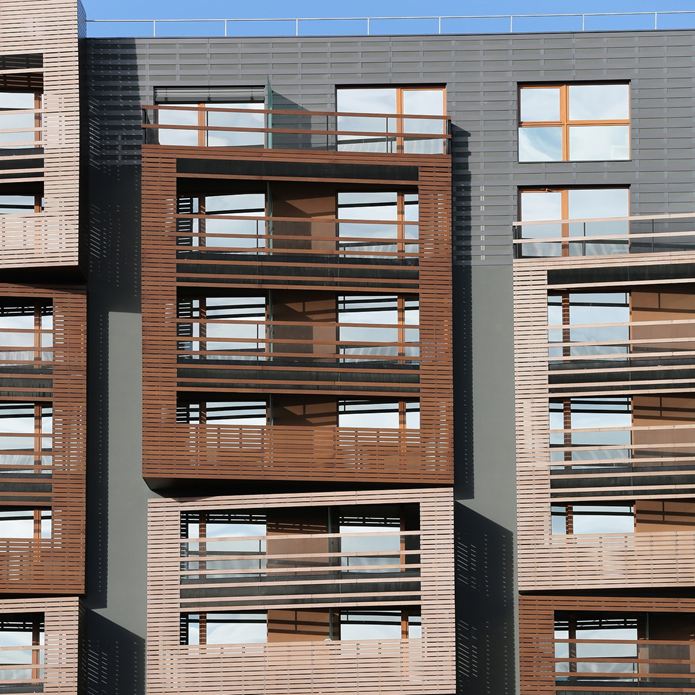
An asymmetrical wood volume. A building with irregular profiles, made up of several panels that characterize the facades. This is the new home of Perathoner, a company that manufactures wood sculptors, in the heart of the Dolomites. And right here, in an area that preserves nature and that makes local traditions an excellence, the Bergmeister Wolf Architekten architecture firm has designed a building in harmony with the context and the nature of the place. nuova sede della Perathoner, Bergmeisterwolf Architekten

Despite being an architecture that fits quite strongly in the landscape thanks to the asymmetrical profile, the new Perathoner headquarters fully respects the values of the place and reflects the company's activities. From the outside, the building looks like a large sculpture, and the different shades of color dictated by wood recall the different stages that characterize the processes of artistic production and craftsmanship. nuova sede della Perathoner, Bergmeisterwolf Architekten

The structure is made of wood, consisting of stacked triangular panels. Instead, the cover is constructed from larch shingles treated with different types of aging, treatments that cause the color to change. In this game, made of panels, there are some openings from which natural light filters. And right here, at night, artificial light is diffused with a strong visual effect.

nuova sede della Perathoner, Bergmeisterwolf Architekten

The materials that complement the architecture are steel and glass.   www.bergmeisterwolf.it

Edoardo Croci

Facades

SAIE 2015 – future challenges: energy conservation and green living

Requalification, recovery of buildings and cutting-edge technology to design the home of the future: this is what was presented at 51° Edition of the SAIE, international building exhibition in Italy.

logoSAIESmartHous_ILNUOVOSAIE

At the heart of the new SALT SMART HOUSE, in the Services area of Bologna fair (held like the interior of a great intelligent and sustainable house), SMART HOUSE LIVING has been presented. This project consists of 4 souls: an exhibition – Smart House Solution – on which was represented a new culture of sustainable living, which allowed visitors to ' touch ' practical applications and innovative technological solutions; a playful and participatory path – the Wheel of Sustainability – to bring the public to the culture to "triple zero" (zero consumption, zero emissions, zero waste); the Forums on the themes of designing, building and inhabiting the houses of tomorrow; the BIG Energy Idea — a ' emotional room ' of innovation told through videos and sounds: a project to push for change through knowledge. SAIE_bologna

In SMART HOUSE LIVING area, energy has been the main topic thanks to the forum "Building & Innovation". In the Digital Smart Building technology how this innovation can revive the construction industry has been the main topic. Many laid optical fiber is still unused. Since last July with the Decree Unlock Italy, "all new buildings must be equipped with a passive multiservice physical infrastructure inside the building, consisting of adequate space and installation of high-speed communications to the fiber optic network termination points". The legislation makes the provision in new homes be mandatory. Esprit Nouveau _SaieSAIE #Idrogeo has been the main new of this edition: it is an informative area and exhibition dedicated to the theme of recovery and securing of the territory from the hydrogeological point of view, that this year 2015 focused on the theme of urban land preservation thanks to the work of engineers and geotechnical in particular. 'Green' has been the guest star in new edition of SAIE, too. Inside the 'Live' path, #Landmaking group has organized ‘To build green’, an area where some of Italian excellences in the field of green have been gathered. The construction industry's interest is directed towards the energy efficiency of existing buildings, as well as through the performance improvement with the aid of new and more modern systems and engineering solutions. Costruire sostenibile

Architecture